AI Assistant Apple

AI Assistant Apple — independent reviews, comparisons, pricing and step-by-step guides on Aizhi.

  • Hallucination (artificial intelligence)

    Hallucination (artificial intelligence)

    In the field of artificial intelligence (AI), a hallucination or artificial hallucination (also called bullshitting, confabulation, or delusion) is a response generated by AI that contains false or misleading information presented as fact. This term draws a loose analogy with human psychology, where a hallucination typically involves false percepts. For example, a chatbot powered by large language models (LLMs), like ChatGPT, may embed plausible-sounding random falsehoods within its generated content. Detecting and mitigating errors and hallucinations pose significant challenges for practical deployment and reliability of LLMs in high-stakes scenarios, such as chip design, supply chain logistics, and medical diagnostics. Some software engineers and statisticians have criticized the specific term "AI hallucination" for unreasonably anthropomorphizing computers. Symbolic artificial intelligence models generally do not produce hallucinations, unlike large language models. == Term == === Origin === Since the 1980s, the term "hallucination" has been used in computer vision with a positive connotation to describe the process of adding detail to an image. For example, the task of generating high-resolution face images from low-resolution inputs is called face hallucination. The first documented use of the term "hallucination" in this sense is in the PhD thesis of Eric Mjolsness in 1986. A notable work is the face hallucination algorithm by Simon Baker and Takeo Kanade published in 1999. In the 2000s, hallucinations were described in statistical machine translation as a failure mode. Since the 2010s, the term has undergone a semantic shift to signify the generation of factually incorrect or misleading outputs by AI systems in tasks like machine translation and object detection. In 2015, hallucinations were identified in visual semantic role labeling tasks by Saurabh Gupta and Jitendra Malik. In 2015, computer scientist Andrej Karpathy used the term "hallucinated" in a blog post to describe his recurrent neural network (RNN) language model generating an incorrect citation link. In 2017, Google researchers used the term to describe the responses generated by neural machine translation (NMT) models when they are not related to the source text, and in 2018, the term was used in computer vision to describe instances where non-existent objects are erroneously detected because of adversarial attacks. In July 2021, Meta warned during its release of BlenderBot 2 that the system is prone to "hallucinations", which Meta defined as "confident statements that are not true". Following OpenAI's ChatGPT release in beta version in November 2022, some users complained that such chatbots often seem to pointlessly embed plausible-sounding random falsehoods within their generated content. Many news outlets, including The New York Times, started to use the term "hallucinations" to describe these models' frequently incorrect or inconsistent responses. In 2023, the Cambridge dictionary updated its definition of hallucination to include this new sense specific to the field of AI. Some researchers have highlighted a lack of consistency in how the term is used, but also identified several alternative terms in the literature, such as confabulations, fabrications, and factual errors. === Definitions and alternatives === Uses, definitions and characterizations of the term "hallucination" in the context of LLMs include: "a tendency to invent facts in moments of uncertainty" (OpenAI, May 2023) "a model's logical mistakes" (OpenAI, May 2023) "fabricating information entirely, but behaving as if spouting facts" (CNBC, May 2023) "making up information" (The Verge, February 2023) "probability distributions" (in scientific contexts) Journalist Benj Edwards, in Ars Technica, writes that the term "hallucination" is controversial, but that some form of metaphor remains necessary; Edwards suggests "confabulation" as an analogy for processes that involve "creative gap-filling". In July 2024, a White House report on fostering public trust in AI research mentioned hallucinations only in the context of reducing them. Notably, when acknowledging David Baker's Nobel Prize-winning work with AI-generated proteins, the Nobel committee avoided the term entirely, instead referring to "imaginative protein creation". Hicks, Humphries, and Slater, in their article in Ethics and Information Technology, argue that the output of LLMs is "bullshit" under Harry Frankfurt's definition of the term, and that the models are "in an important way indifferent to the truth of their outputs", with true statements only accidentally true, and false ones accidentally false. Some researchers also use the derogatory term "botshit", often referring to uncritical use of AI. === Criticism === In the scientific community, some researchers avoid the term "hallucination", seeing it as potentially misleading. It has been criticized by Usama Fayyad, executive director of the Institute for Experimental Artificial Intelligence at Northeastern University, on the grounds that it misleadingly personifies large language models and is vague. Mary Shaw said, "The current fashion for calling generative AI's errors 'hallucinations' is appalling. It anthropomorphizes the software, and it spins actual errors as somehow being idiosyncratic quirks of the system even when they're objectively incorrect." In Salon, statistician Gary Smith argues that LLMs "do not understand what words mean" and consequently that the term "hallucination" unreasonably anthropomorphizes the machine. Murray Shanahan argues that anthropomorphic framing of LLM capabilities, including terms like "hallucination", encourages users and researchers to attribute cognitive processes to systems that operate through statistical pattern completion, and advocates for more careful linguistic practices when discussing LLM behavior. Kristina Šekrst argues that applying psychological vocabulary to LLM outputs obscures the difference between the appearance of mental properties and their genuine presence. Förster & Skop assert that tech companies use the hallucination metaphor to anthropomorphize models and deflect responsibility for non-factual outputs. Some see the AI outputs not as illusory but as prospective—that is, having some chance of being true, similar to early-stage scientific conjectures. The term has also been criticized for its association with psychedelic drug experiences. == In natural language generation == In natural language generation, there are several reasons why natural language models hallucinate: === Hallucination from data === Hallucinations can stem from incomplete, inaccurate or unrepresentative data sets. === Modeling-related causes === The pre-training of generative pretrained transformers (GPT) involves predicting the next word. It incentivizes GPT models to "give a guess" about what the next word is, even when they lack information. Some researchers take an anthropomorphic perspective and posit that hallucinations arise from a tension between novelty and usefulness. For instance, Amabile and Pratt define human creativity as the production of novel and useful ideas. By extension, a focus on novelty in machine creativity can lead to the production of original but inaccurate responses—that is, falsehoods—whereas a focus on usefulness may result in memorized content lacking originality. By 2022, newspapers such as The New York Times expressed concern that, as the adoption of bots based on large language models continued to grow, unwarranted user confidence in bot output could lead to problems. === Interpretability research === In 2025, interpretability research by Anthropic on the LLM Claude identified internal circuits that cause it to decline to answer questions unless it knows the answer. By default, the circuit is active and the LLM doesn't answer. When the LLM has sufficient information, these circuits are inhibited and the LLM answers the question. Hallucinations were found to occur when this inhibition happens incorrectly, such as when Claude recognizes a name but lacks sufficient information about that person, causing it to generate plausible but untrue responses. === Examples === On 15 November 2022, researchers from Meta AI published Galactica, designed to "store, combine and reason about scientific knowledge". Content generated by Galactica came with the warning: "Outputs may be unreliable! Language Models are prone to hallucinate text." In one case, when asked to draft a paper on creating avatars, Galactica cited a fictitious paper from a real author who works in the relevant area. Meta withdrew Galactica on 17 November due to offensiveness and inaccuracy. OpenAI's ChatGPT, released in beta version to the public on November 30, 2022, was based on the foundation model GPT-3.5 (a revision of GPT-3). Professor Ethan Mollick of Wharton called it an "omniscient, eager-to-please intern who sometimes lies to you". Data scientist Teresa Kuba

    Read more →
  • Fuzzy measure theory

    Fuzzy measure theory

    In mathematics, fuzzy measure theory considers generalized measures in which the additive property is replaced by the weaker property of monotonicity. The central concept of fuzzy measure theory is the fuzzy measure (also capacity, see ), which was introduced by Choquet in 1953 and independently defined by Sugeno in 1974 in the context of fuzzy integrals. There exists a number of different classes of fuzzy measures including plausibility/belief measures, possibility/necessity measures, and probability measures, which are a subset of classical measures. == Definitions == Let X {\displaystyle \mathbf {X} } be a universe of discourse, C {\displaystyle {\mathcal {C}}} be a class of subsets of X {\displaystyle \mathbf {X} } , and E , F ∈ C {\displaystyle E,F\in {\mathcal {C}}} . A function g : C → R {\displaystyle g:{\mathcal {C}}\to \mathbb {R} } where ∅ ∈ C ⇒ g ( ∅ ) = 0 {\displaystyle \emptyset \in {\mathcal {C}}\Rightarrow g(\emptyset )=0} E ⊆ F ⇒ g ( E ) ≤ g ( F ) {\displaystyle E\subseteq F\Rightarrow g(E)\leq g(F)} is called a fuzzy measure. A fuzzy measure is called normalized or regular if g ( X ) = 1 {\displaystyle g(\mathbf {X} )=1} . == Properties of fuzzy measures == A fuzzy measure is: additive if for any E , F ∈ C {\displaystyle E,F\in {\mathcal {C}}} such that E ∩ F = ∅ {\displaystyle E\cap F=\emptyset } , we have g ( E ∪ F ) = g ( E ) + g ( F ) . {\displaystyle g(E\cup F)=g(E)+g(F).} ; supermodular if for any E , F ∈ C {\displaystyle E,F\in {\mathcal {C}}} , we have g ( E ∪ F ) + g ( E ∩ F ) ≥ g ( E ) + g ( F ) {\displaystyle g(E\cup F)+g(E\cap F)\geq g(E)+g(F)} ; submodular if for any E , F ∈ C {\displaystyle E,F\in {\mathcal {C}}} , we have g ( E ∪ F ) + g ( E ∩ F ) ≤ g ( E ) + g ( F ) {\displaystyle g(E\cup F)+g(E\cap F)\leq g(E)+g(F)} ; superadditive if for any E , F ∈ C {\displaystyle E,F\in {\mathcal {C}}} such that E ∩ F = ∅ {\displaystyle E\cap F=\emptyset } , we have g ( E ∪ F ) ≥ g ( E ) + g ( F ) {\displaystyle g(E\cup F)\geq g(E)+g(F)} ; subadditive if for any E , F ∈ C {\displaystyle E,F\in {\mathcal {C}}} such that E ∩ F = ∅ {\displaystyle E\cap F=\emptyset } , we have g ( E ∪ F ) ≤ g ( E ) + g ( F ) {\displaystyle g(E\cup F)\leq g(E)+g(F)} ; symmetric if for any E , F ∈ C {\displaystyle E,F\in {\mathcal {C}}} , we have | E | = | F | {\displaystyle |E|=|F|} implies g ( E ) = g ( F ) {\displaystyle g(E)=g(F)} ; Boolean if for any E ∈ C {\displaystyle E\in {\mathcal {C}}} , we have g ( E ) = 0 {\displaystyle g(E)=0} or g ( E ) = 1 {\displaystyle g(E)=1} . Understanding the properties of fuzzy measures is useful in application. When a fuzzy measure is used to define a function such as the Sugeno integral or Choquet integral, these properties will be crucial in understanding the function's behavior. For instance, the Choquet integral with respect to an additive fuzzy measure reduces to the Lebesgue integral. In discrete cases, a symmetric fuzzy measure will result in the ordered weighted averaging (OWA) operator. Submodular fuzzy measures result in convex functions, while supermodular fuzzy measures result in concave functions when used to define a Choquet integral. == Möbius representation == Let g be a fuzzy measure. The Möbius representation of g is given by the set function M, where for every E , F ⊆ X {\displaystyle E,F\subseteq X} , M ( E ) = ∑ F ⊆ E ( − 1 ) | E ∖ F | g ( F ) . {\displaystyle M(E)=\sum _{F\subseteq E}(-1)^{|E\backslash F|}g(F).} The equivalent axioms in Möbius representation are: M ( ∅ ) = 0 {\displaystyle M(\emptyset )=0} . ∑ F ⊆ E | i ∈ F M ( F ) ≥ 0 {\displaystyle \sum _{F\subseteq E|i\in F}M(F)\geq 0} , for all E ⊆ X {\displaystyle E\subseteq \mathbf {X} } and all i ∈ E {\displaystyle i\in E} A fuzzy measure in Möbius representation M is called normalized if ∑ E ⊆ X M ( E ) = 1. {\displaystyle \sum _{E\subseteq \mathbf {X} }M(E)=1.} Möbius representation can be used to give an indication of which subsets of X interact with one another. For instance, an additive fuzzy measure has Möbius values all equal to zero except for singletons. The fuzzy measure g in standard representation can be recovered from the Möbius form using the Zeta transform: g ( E ) = ∑ F ⊆ E M ( F ) , ∀ E ⊆ X . {\displaystyle g(E)=\sum _{F\subseteq E}M(F),\forall E\subseteq \mathbf {X} .} == Simplification assumptions for fuzzy measures == Fuzzy measures are defined on a semiring of sets or monotone class, which may be as granular as the power set of X, and even in discrete cases the number of variables can be as large as 2|X|. For this reason, in the context of multi-criteria decision analysis and other disciplines, simplification assumptions on the fuzzy measure have been introduced so that it is less computationally expensive to determine and use. For instance, when it is assumed the fuzzy measure is additive, it will hold that g ( E ) = ∑ i ∈ E g ( { i } ) {\displaystyle g(E)=\sum _{i\in E}g(\{i\})} and the values of the fuzzy measure can be evaluated from the values on X. Similarly, a symmetric fuzzy measure is defined uniquely by |X| values. Two important fuzzy measures that can be used are the Sugeno- or λ {\displaystyle \lambda } -fuzzy measure and k-additive measures, introduced by Sugeno and Grabisch respectively. === Sugeno λ-measure === The Sugeno λ {\displaystyle \lambda } -measure is a special case of fuzzy measures defined iteratively. It has the following definition: ==== Definition ==== Let X = { x 1 , … , x n } {\displaystyle \mathbf {X} =\left\lbrace x_{1},\dots ,x_{n}\right\rbrace } be a finite set and let λ ∈ ( − 1 , + ∞ ) {\displaystyle \lambda \in (-1,+\infty )} . A Sugeno λ {\displaystyle \lambda } -measure is a function g : 2 X → [ 0 , 1 ] {\displaystyle g:2^{X}\to [0,1]} such that g ( X ) = 1 {\displaystyle g(X)=1} . if A , B ⊆ X {\displaystyle A,B\subseteq \mathbf {X} } (alternatively A , B ∈ 2 X {\displaystyle A,B\in 2^{\mathbf {X} }} ) with A ∩ B = ∅ {\displaystyle A\cap B=\emptyset } then g ( A ∪ B ) = g ( A ) + g ( B ) + λ g ( A ) g ( B ) {\displaystyle g(A\cup B)=g(A)+g(B)+\lambda g(A)g(B)} . As a convention, the value of g at a singleton set { x i } {\displaystyle \left\lbrace x_{i}\right\rbrace } is called a density and is denoted by g i = g ( { x i } ) {\displaystyle g_{i}=g(\left\lbrace x_{i}\right\rbrace )} . In addition, we have that λ {\displaystyle \lambda } satisfies the property λ + 1 = ∏ i = 1 n ( 1 + λ g i ) {\displaystyle \lambda +1=\prod _{i=1}^{n}(1+\lambda g_{i})} . Tahani and Keller as well as Wang and Klir have shown that once the densities are known, it is possible to use the previous polynomial to obtain the values of λ {\displaystyle \lambda } uniquely. === k-additive fuzzy measure === The k-additive fuzzy measure limits the interaction between the subsets E ⊆ X {\displaystyle E\subseteq X} to size | E | = k {\displaystyle |E|=k} . This drastically reduces the number of variables needed to define the fuzzy measure, and as k can be anything from 1 (in which case the fuzzy measure is additive) to X, it allows for a compromise between modelling ability and simplicity. ==== Definition ==== A discrete fuzzy measure g on a set X is called k-additive ( 1 ≤ k ≤ | X | {\displaystyle 1\leq k\leq |\mathbf {X} |} ) if its Möbius representation verifies M ( E ) = 0 {\displaystyle M(E)=0} , whenever | E | > k {\displaystyle |E|>k} for any E ⊆ X {\displaystyle E\subseteq \mathbf {X} } , and there exists a subset F with k elements such that M ( F ) ≠ 0 {\displaystyle M(F)\neq 0} . == Shapley and interaction indices == In game theory, the Shapley value or Shapley index is used to indicate the weight of a game. Shapley values can be calculated for fuzzy measures in order to give some indication of the importance of each singleton. In the case of additive fuzzy measures, the Shapley value will be the same as each singleton. For a given fuzzy measure g, and | X | = n {\displaystyle |\mathbf {X} |=n} , the Shapley index for every i , … , n ∈ X {\displaystyle i,\dots ,n\in X} is: ϕ ( i ) = ∑ E ⊆ X ∖ { i } ( n − | E | − 1 ) ! | E | ! n ! [ g ( E ∪ { i } ) − g ( E ) ] . {\displaystyle \phi (i)=\sum _{E\subseteq \mathbf {X} \backslash \{i\}}{\frac {(n-|E|-1)!|E|!}{n!}}[g(E\cup \{i\})-g(E)].} The Shapley value is the vector ϕ ( g ) = ( ψ ( 1 ) , … , ψ ( n ) ) . {\displaystyle \mathbf {\phi } (g)=(\psi (1),\dots ,\psi (n)).}

    Read more →
  • Xaitment

    Xaitment

    xaitment is a German-based company that develops and sells artificial intelligence (AI) software to video game developers and simulation developers. The company was founded in 2004 by Dr. Andreas Gerber, and is a spin-off of the German Research Centre for Artificial Intelligence, or DFKI. xaitment has its main office in Quierschied, Germany, and field offices in San Francisco and China. == Products == xaitment currently sells two AI software modules: xaitMap and xaitControl. xaitMap provides runtime libraries and graphical tools for navigation mesh generation (also called NavMesh generation), pathfinding, dynamic collision avoidance, and individual and crowd movement. xaitControl is a finite-state machine for game logic and character behavior modeling that also includes a real-time debugger. On January 11, 2012, xaitment announced that it making its source code for these modules available to "all current and future US and European licensees". On February 22, 2012 xaitment released two new plug-ins, xaitMap and xaitControl for the Unity Game Engine. The full versions are available for PC (Windows and Linux), PlayStation 3, Xbox 360 and Wii. The pathfinding plug-in is available with a Windows dev environment, but can deployed on iOS, Mac, Android and the Unity Web Player. == Partners == xaitment's AI software is currently integrated into the Unity game engine, Havok's Vision Engine, Bohemia Interactive's VBS2 Simulation Engine, GameBase's Gamebryo game engine. == Customers == xaitment sells its AI software products to video game developers and military and civil simulation developers. Current customers include Tencent, gamania, TML Studios, Emobi Games, IP Keys and others. A full list of customers can be found on xaitment's website.

    Read more →
  • Micah Xavier Johnson

    Micah Xavier Johnson

    Micah Xavier Johnson (July 2, 1991 – July 8, 2016) was an American Army reserve Afghan war veteran, black nationalist, and mass murderer who perpetrated the 2016 shooting of Dallas police officers during a Black Lives Matter protest. He ambushed and killed five officers and wounded eleven others in Downtown, Dallas, Texas. He was killed by police during a standoff after expressing anger over police killings of black men. The shootings were the second-deadliest targeted attack on law enforcement officers in U.S. history, surpassed only by the September 11 attacks. == Early life == Micah Xavier Johnson was born in Magee, Mississippi, on July 2, 1991, and he was raised in Mesquite, Texas. When he was four years old, his parents divorced. At 17, Johnson enrolled at John Horn High School, where he joined the Junior Reserve Officers' Training Corps, as reported by the Mesquite Independent school district. He faced academic challenges, graduating in 2009 with a 1.98 GPA and ranking 430th out of 453 students in his class. In Spring 2011, Johnson registered for four courses at Richland college but did not complete any. Evidence suggests his enrollment at Richland gave him access to El Centro College, due to his pre-planned and coordinated movements throughout Building B during his standoff with police in 2016. == Military service == === Enlistment and early service === Micah Xavier Johnson enlisted in the U.S. Army Reserve in March 2009 at the age of 18, shortly after graduating high school in Mesquite, Texas. His initial service was primarily stateside, where he trained as a carpentry and masonry specialist (military occupational specialty 51B). This role involved engineering tasks such as construction and repair in support of military operations. During his reserve tenure, Johnson served part-time while living at home, and he was described by family and friends as initially idealistic about the military, even aspiring to become a police officer. === Deployment to Afghanistan === In September 2013, Johnson was activated for full-time duty and deployed to Afghanistan as part of the 420th Engineer Brigade, a unit based in Seagoville, Texas. His tour began in November 2013 and lasted approximately eight months, ending in July 2014. During this period, he performed non-combat engineering duties, though the stresses of serving in a combat zone were noted by those close to him. Associates from his service later suggested he experienced significant psychological strain, including the loss of friends and general disillusionment with military life, which contrasted with his pre-deployment enthusiasm. His mother later reflected that "the military was not what Micah thought it would be." === Sexual harassment allegation and early return === About six months into his deployment, in May 2014, Johnson faced a serious accusation of sexual harassment from a higher-ranking female soldier. She filed for a military protective order against him, prompting an investigation. As a result, his chain of command recommended an "other than honorable" discharge—the second (more severe is a dishonorable discharge, which does not require a court martial) most severe administrative separation short of a court-martial—and he was sent back to the United States ahead of schedule. Despite this, Johnson was not court-martialed, and the case did not lead to criminal charges. A military lawyer who represented him described the handling as unusual, noting that "someone really screwed up" in allowing him to avoid harsher consequences. === Post-deployment and discharge === Upon returning stateside in August 2014, Johnson resumed reserve duties with his engineering brigade until April 2015. He was honorably discharged at the rank of private first class (E-3), a relatively low junior enlisted rank after six years of service, which military sources attributed partly to the unresolved harassment allegation impacting his promotions and evaluations. Friends and family observed a marked change in his demeanor post-deployment: he became more reclusive, resentful toward the government, and withdrawn, with some speculating that the Afghanistan experience and the scandal contributed to a "small breakdown." In July 2016, following the Dallas shooting, the U.S. Army launched an internal review of his service record, including the harassment claims, to assess whether all misconduct allegations had been fully investigated. == Shootings == On July 7, 2016, a peaceful Black Lives Matter protest marched through downtown Dallas, Texas, drawing about 800 demonstrators. The event responded to the recent police killings of Alton Sterling in Baton Rouge, Louisiana, on July 5, and Philando Castile in Falcon Heights, Minnesota, on July 6—both black men shot during encounters captured on video. Around 100 officers monitored the march, which passed near El Centro College without incident until gunfire erupted around 8:45 p.m. Johnson arrived in a dark SUV, armed with an SKS semi-automatic rifle, a handgun, extra ammunition, and ballistic vests. He parked near the protest's end, chatted briefly with two officers, then opened fire on police from an elevated position on Lamar Street (now Botham Jean Boulevard). He shot from behind barriers, through windows, and while moving, targeting white officers specifically. The ambush killed five officers and wounded seven more, plus two civilians. Gunfire scattered protesters in panic as Johnson used military-style tactics, like quick position changes, to prolong the assault. === Standoff and Johnson's end === Johnson fled into El Centro College's Building C, then Building B, navigating pre-planned routes with familiarity from prior enrollment at nearby Richland College. He barricaded in a parking garage, wounding more officers in close-range fights. During two-hour negotiations, he taunted police via phone—laughing, singing, asking kill counts, and claiming planted bombs (none found). He admitted solo action, rage at White officers, and no group ties. At 2:30 a.m. on July 8, SWAT ended the standoff by detonating a bomb via remote-controlled robot in the garage, killing Johnson. This marked the first U.S. police use of such a tactic. === Victims and investigation findings === The slain officers were: Brent Thompson (Transit Authority, 36), Patrick Zamarripa (Dallas PD, 33), Michael Krol (Dallas PD, 40), Lorne Ahrens (Dallas PD, 48), and Michael Smith (Dallas PD, 55). Wounded officers included Sheik Smith, John Mitchell, and others; civilians She Tamara El-Sobky and Hillary Castro. Searches of Johnson's home revealed bomb-making materials, rifles, vests, and notes on tactics, suggesting plans for a larger attack. He had practiced explosions and honed skills post-discharge, including marksmanship. === Aftermath and impact === Dallas mourned with vigils and memorials, while national protests against police violence continued amid grief. President Barack Obama, the first African American president of the United States, called Johnson a "demented individual" and formed a task force on race and policing. The incident fueled debates on gun control, race relations, and veteran mental health—Johnson had sought VA treatment for stress and anxiety but showed no prior violent signs to friends. El Centro College canceled all classes on July 8. Police barricaded the perimeter and began canvassing the crime scene. The explosion that killed Johnson also destroyed the school's servers, further delaying reopening. The school partially reopened on July 20, with staff returning that day and students on the following day. Buildings A, B, and C remained closed pending the FBI investigation. == Motive == An investigation into his online activities uncovered his interest in black nationalist groups. The Southern Poverty Law Center (SPLC), and news outlets reported that Johnson "liked" the Facebook pages of black nationalist organizations such as the New Black Panther Party (NBPP), Nation of Islam, and Black Riders Liberation Party, three groups which are listed by the SPLC as hate groups. On Facebook, Johnson posted an angry and "disjointed" post against White people on July 2, several days before the attack. NBPP head Quanell X said after the shooting that Johnson had been a member of the NBPP's Houston chapter for about six months, several years before. Quanell X added that Johnson had been "asked to leave" the group for violating the organization's "chain of command" and espousing dangerous rhetoric, such as asking the NBPP why they had not purchased more weapons and ammunition, and expressing his desire to harm black church preachers because he believed they were more interested in money than God. Following the shooting, a national NBPP leader distanced the group from Johnson, saying that he "was not a member of" the party. Further investigation into his digital footprint showed that Johnson visited the sites of Marxist Leninist groups associated with "Revolutionary Black Nationalism",

    Read more →
  • PagedAttention

    PagedAttention

    PagedAttention is an attention algorithm for efficient serving of large language models (LLMs). It was introduced in 2023 by Woosuk Kwon and colleagues in the paper Efficient Memory Management for Large Language Model Serving with PagedAttention, alongside the vLLM serving engine. The method stores the key–value cache used during autoregressive decoding in fixed-size blocks that can be mapped to non-contiguous physical memory, borrowing ideas from virtual memory, paging, and operating system design. == Background == In transformer inference, the key–value cache grows with sequence length and the number of concurrent requests. Kwon et al. argued that earlier serving systems typically reserved contiguous cache regions in advance, which caused reserved space, internal fragmentation, and external fragmentation. In their experiments, the paper reported that the effective memory utilization of previous systems could fall as low as 20.4%. == Description == PagedAttention partitions the cache of each sequence into fixed-size KV blocks. A request's cache is represented as a sequence of logical blocks, while a block table maps those logical blocks to physical GPU-memory blocks. As a result, neighboring logical blocks do not need to be contiguous in physical memory, and new blocks can be allocated on demand as generation proceeds. The design also makes it easier to share cache state across related decoding paths. In vLLM, physical blocks can be reference-counted and shared among requests or branches, with block-granularity copy-on-write used when a shared block must be modified. The original paper applied this design to parallel sampling, beam search, and prompts with shared prefixes. == Mathematical formulation == For a query token i {\displaystyle i} in causal self-attention, the standard attention output can be written as a i j = exp ⁡ ( q i ⊤ k j / d ) ∑ t = 1 i exp ⁡ ( q i ⊤ k t / d ) , o i = ∑ j = 1 i a i j v j {\displaystyle a_{ij}={\frac {\exp(\mathbf {q} _{i}^{\top }\mathbf {k} _{j}/{\sqrt {d}})}{\sum _{t=1}^{i}\exp(\mathbf {q} _{i}^{\top }\mathbf {k} _{t}/{\sqrt {d}})}},\;\mathbf {o} _{i}=\sum _{j=1}^{i}a_{ij}\mathbf {v} _{j}} where q i {\displaystyle \mathbf {q} _{i}} , k j {\displaystyle \mathbf {k} _{j}} , and v j {\displaystyle \mathbf {v} _{j}} are the query, key, and value vectors, and d {\displaystyle d} is the attention dimension. If the cache is partitioned into blocks of size B {\displaystyle B} , the key and value blocks may be written as K j = ( k ( j − 1 ) B + 1 , … , k j B ) , V j = ( v ( j − 1 ) B + 1 , … , v j B ) {\displaystyle \mathbf {K} _{j}=(\mathbf {k} _{(j-1)B+1},\ldots ,\mathbf {k} _{jB}),\;\mathbf {V} _{j}=(\mathbf {v} _{(j-1)B+1},\ldots ,\mathbf {v} _{jB})} PagedAttention then performs the computation blockwise: A i j = exp ⁡ ( q i ⊤ K j / d ) ∑ t = 1 ⌈ i / B ⌉ exp ⁡ ( q i ⊤ K t / d ) , o i = ∑ j = 1 ⌈ i / B ⌉ V j A i j ⊤ {\displaystyle \mathbf {A} _{ij}={\frac {\exp(\mathbf {q} _{i}^{\top }\mathbf {K} _{j}/{\sqrt {d}})}{\sum _{t=1}^{\lceil i/B\rceil }\exp(\mathbf {q} _{i}^{\top }\mathbf {K} _{t}/{\sqrt {d}})}},\;\mathbf {o} _{i}=\sum _{j=1}^{\lceil i/B\rceil }\mathbf {V} _{j}\mathbf {A} _{ij}^{\top }} where A i j {\displaystyle \mathbf {A} _{ij}} is the vector of attention scores for the j {\displaystyle j} -th KV block. In the formulation given by Kwon et al., this preserves the causal attention calculation while allowing the key and value blocks to reside in non-contiguous physical memory. == Performance and use == The vLLM paper reported that, on its evaluated workloads, the use of PagedAttention and the associated memory-management design improved serving throughput by 2–4× over the compared baselines, including FasterTransformer and Orca, while preserving model outputs. In experiments on OPT-13B with the Alpaca trace, the paper also reported memory savings of 6.1–9.8% for parallel sampling and 37.6–55.2% for beam search through KV-block sharing. A 2024 survey of LLM serving systems described PagedAttention as having become an industry norm in LLM serving frameworks, citing support in TGI, vLLM, and TensorRT-LLM. == Limitations and alternatives == Subsequent work has described trade-offs in the approach. The 2025 vAttention paper argued that PagedAttention requires attention kernels to be rewritten to support paging and increases software complexity, portability issues, redundancy, and execution overhead, proposing instead a memory manager that keeps the cache contiguous in virtual memory while relying on demand paging for physical allocation. === vAttention === Unlike PagedAttention, vAttention does not introduce a different attention rule; it retains the standard attention computation Attention ⁡ ( q i , K , V ) = softmax ⁡ ( q i K ⊤ s c a l e ) V . {\displaystyle \operatorname {Attention} (q_{i},K,V)=\operatorname {softmax} \left({\frac {q_{i}K^{\top }}{\mathrm {scale} }}\right)V.} In the notation of Prabhu et al., the key and value tensors for a request seen so far are K , V ∈ R L ′ × ( H × D ) {\displaystyle K,V\in \mathbb {R} ^{L'\times (H\times D)}} , where L ′ {\displaystyle L'} is the context length seen so far, H {\displaystyle H} is the number of KV heads on a worker, and D {\displaystyle D} is the dimension of each KV head. In systems prior to PagedAttention, the K cache (or V cache) at each layer of a worker is typically allocated as a 4D tensor of shape [ B , L , H , D ] , {\displaystyle [B,L,H,D],} where B {\displaystyle B} is batch size and L {\displaystyle L} is the maximum context length supported by the model. vAttention preserves this contiguous virtual-memory view while deferring physical-memory allocation to runtime. A serving framework maintains separate K and V tensors for each layer, so vAttention reserves 2 N {\displaystyle 2N} virtual-memory buffers on a worker, where N {\displaystyle N} is the number of layers managed by that worker. The maximum size of one virtual-memory buffer is B S = B × S , {\displaystyle BS=B\times S,} where S {\displaystyle S} is the maximum size of a single request's per-layer K cache (or V cache) on a worker. The paper defines S = L × H × D × P , {\displaystyle S=L\times H\times D\times P,} where P {\displaystyle P} is the number of bytes needed to store one element. In this formulation, vAttention keeps the KV cache contiguous in virtual memory and relies on demand paging for physical allocation, rather than modifying the attention kernel to operate over non-contiguous KV-cache blocks.

    Read more →
  • Miss AI

    Miss AI

    Miss AI is an annual international artificial intelligence beauty pageant run by the British company Fanvue. It is the first beauty pageant for AI-generated personas. == History == Miss AI's inaugural contest was organized by Fanvue as a part of the World AI Creator Awards (WAICAs) in 2024. The winner is selected by a panel of judges which consists of both humans and AI-generated individuals. The Moroccan virtual influencer Kenza Layli was crowned with the inaugural title while Lalina Valina and Olivia C remained the first and second runners-up respectively. == Competition == The creators are eligible to take part in this competition as long as the models are entirely AI-generated and have a social media presence. The judges evaluate contestants' three main categories – Beauty, Tech, & Social clout and rank them according the overall points earned from these categories. The Guardian commented that "AI models take every toxic gendered beauty norm and bundle them up into completely unrealistic package". == Winners ==

    Read more →
  • Generative engine optimization

    Generative engine optimization

    Generative engine optimization (GEO) is one of the names given to the practice of structuring digital content and managing online presence to improve visibility in responses generated by generative artificial intelligence (AI) systems. The practice influences the way large language models (LLMs) retrieve, summarize, and present information in response to user queries. Related terms include answer engine optimization (AEO) and artificial intelligence optimization (AIO). The concept of GEO first appeared in response to generative AI technologies being integrated into mainstream search and information retrieval systems. Tools are used to monitor how websites and brands are cited, referenced, or incorporated into responses produced by large language models. == Terminology == Several overlapping terms describe related practices, and usage varies across practitioners, vendors, and publications. No consensus definition distinguishing these terms had been established in the academic literature as of early 2026, and the terms are frequently used interchangeably in trade and practitioner contexts. Other terms for the same concept include answer engine optimization (AEO), large language model optimization (LLMO), artificial intelligence optimization (AIO), and AI SEO. In 2026, Google released documentation entitled "Optimizing your website for generative AI features on Google Search." According to this documentation, "optimizing for generative AI search is optimizing for the search experience, and thus still SEO.” This position had previously been shared at conferences, with 2026 being the first time Google released official documentation stating it. == Factors influencing generative engine optimization == By early 2026, the focus of GEO practitioners shifted from simple keyword placement to "semantic relevance", a metric driven by the integration of advertising into conversational AI. OpenAI and Google began monetizing AI search results, which is not currently considered an aspect of generative engine optimization but is adjacent.

    Read more →
  • Vague set

    Vague set

    In mathematics, vague sets are an extension of fuzzy sets. In a fuzzy set, each object is assigned a single value in the interval [0,1] reflecting its grade of membership. This single value does not allow a separation of evidence for membership and evidence against membership. Gau et al. proposed the notion of vague sets, where each object is characterized by two different membership functions: a true membership function and a false membership function. This kind of reasoning is also called interval membership, as opposed to point membership in the context of fuzzy sets. == Mathematical definition == A vague set V {\displaystyle V} is characterized by its true membership function t v ( x ) {\displaystyle t_{v}(x)} its false membership function f v ( x ) {\displaystyle f_{v}(x)} with 0 ≤ t v ( x ) + f v ( x ) ≤ 1 {\displaystyle 0\leq t_{v}(x)+f_{v}(x)\leq 1} The grade of membership for x is not a crisp value anymore, but can be located in [ t v ( x ) , 1 − f v ( x ) ] {\displaystyle [t_{v}(x),1-f_{v}(x)]} . This interval can be interpreted as an extension to the fuzzy membership function. The vague set degenerates to a fuzzy set, if 1 − f v ( x ) = t v ( x ) {\displaystyle 1-f_{v}(x)=t_{v}(x)} for all x. The uncertainty of x is the difference between the upper and lower bounds of the membership interval; it can be computed as ( 1 − f v ( x ) ) − t v ( x ) {\displaystyle (1-f_{v}(x))-t_{v}(x)} .

    Read more →
  • Non-photorealistic rendering

    Non-photorealistic rendering

    Non-photorealistic rendering (NPR) is an area of computer graphics that focuses on enabling a wide variety of expressive styles for digital art, in contrast to traditional computer graphics, which focuses on photorealism. NPR is inspired by other artistic modes such as painting, drawing, technical illustration, and animated cartoons. NPR has appeared in movies and video games in the form of cel-shaded animation (also known as "toon" shading) as well as in scientific visualization, architectural illustration and experimental animation. == History and criticism of the term == The term non-photorealistic rendering is believed to have been coined by the SIGGRAPH 1990 papers committee, who held a session entitled "Non Photo Realistic Rendering". The term has received some criticism: The term "photorealism" has different meanings for graphics researchers (see "photorealistic rendering") and artists. For artists—who are the target consumers of NPR techniques—it refers to a school of painting that focuses on reproducing the effect of a camera lens, with all the distortion and hyper-reflections that it creates. For graphics researchers, however, it refers to an image that is visually indistinguishable from reality. In fact, graphics researchers lump the kinds of visual distortions that are used by photorealist painters into "non-photorealism". Describing something by what it is not is problematic. Equivalent (made-up) comparisons might be "non-elephant biology" or "non-geometric mathematics". NPR researchers have stated that they expect the term will disappear eventually and be replaced by the now more general term "computer graphics", with "photorealistic graphics" being the term used to describe "traditional" computer graphics. Many techniques that are used to create 'non-photorealistic' images are not rendering techniques. They are modelling techniques, or post-processing techniques. While the latter are coming to be known as 'image-based rendering', sketch-based modelling techniques, cannot technically be included under this heading, which is very inconvenient for conference organisers. The first conference on non-photorealistic animation and rendering included a discussion of possible alternative names. Among those suggested were "expressive graphics", "artistic rendering", "non-realistic graphics", "art-based rendering", and "psychographics". All of these terms have been used in various research papers on the topic, but the "non-photorealistic" term seems to have nonetheless taken hold. The first technical meeting dedicated to NPR was the ACM-sponsored Symposium on Non-Photorealistic Rendering and Animation(NPAR) in 2000. NPAR is traditionally co-located with the Annecy Animated Film Festival, running on even numbered years. From 2007 onward, NPAR began to also run on odd-numbered years, co-located with ACM SIGGRAPH. == 3D == Three-dimensional NPR is the style that is most commonly seen in video games and movies. The output from this technique is almost always a 3D model that has been modified from the original input model to portray a new artistic style. In many cases, the geometry of the model is identical to the original geometry, and only the material applied to the surface is modified. With increased availability of programmable GPU's, shaders have allowed NPR effects to be applied to the rasterised image that is to be displayed to the screen. The majority of NPR techniques applied to 3D geometry are intended to make the scene appear two-dimensional. NPR techniques for 3D images include cel shading and Gooch shading. Many methods can be used to draw stylized outlines and strokes from 3D models, including occluding contours and Suggestive contours. For enhanced legibility, the most useful technical illustrations for technical communication are not necessarily photorealistic. Non-photorealistic renderings, such as exploded view diagrams, greatly assist in showing placement of parts in a complex system. Cartoon rendering, also called cel shading or toon shading, is a non-photorealistic rendering technique used to give 3D computer graphics a flat, cartoon-like appearance. Its defining feature is the use of distinct shading colors rather than smooth gradients, producing a look reminiscent of comic books or animated films. This technique is often used to blend 3D objects and environments with 2D hand-animated elements while maintaining a consistent look. Treasure Planet movie by Disney is an example of blending these techniques. == 2D == The input to a two dimensional NPR system is typically an image or video. The output is a typically an artistic rendering of that input imagery (for example in a watercolor, painterly or sketched style) although some 2D NPR serves non-artistic purposes e.g. data visualization. The artistic rendering of images and video (often referred to as image stylization) traditionally focused upon heuristic algorithms that seek to simulate the placement of brush strokes on a digital canvas. Arguably, the earliest example of 2D NPR is Paul Haeberli's 'Paint by Numbers' at SIGGRAPH 1990. This (and similar interactive techniques) provide the user with a canvas that they can "paint" on using the cursor — as the user paints, a stylized version of the image is revealed on the canvas. This is especially useful for people who want to simulate different sizes of brush strokes according to different areas of the image. Subsequently, basic image processing operations using gradient operators or statistical moments were used to automate this process and minimize user interaction in the late nineties (although artistic control remains with the user via setting parameters of the algorithms). This automation enabled practical application of 2D NPR to video, for the first time in the living paintings of the movie What Dreams May Come (1998). More sophisticated image abstractions techniques were developed in the early 2000s harnessing computer vision operators e.g. image salience, or segmentation operators to drive stroke placement. Around this time, machine learning began to influence image stylization algorithms notably image analogy that could learn to mimic the style of an existing artwork. The advent of deep learning has re-kindled activity in image stylization, notably with neural style transfer (NST) algorithms that can mimic a wide gamut of artistic styles from single visual examples. These algorithms underpin mobile apps capable of the same e.g. Prisma In addition to the above stylization methods, a related class of techniques in 2D NPR address the simulation of artistic media. These methods include simulating the diffusion of ink through different kinds of paper, and also of pigments through water for simulation of watercolor. == Artistic rendering == Artistic rendering is the application of visual art styles to rendering. For photorealistic rendering styles, the emphasis is on accurate reproduction of light-and-shadow and the surface properties of the depicted objects, composition, or other more generic qualities. When the emphasis is on unique interpretive rendering styles, visual information is interpreted by the artist and displayed accordingly using the chosen art medium and level of abstraction in abstract art. In computer graphics, interpretive rendering styles are known as non-photorealistic rendering styles, but may be used to simplify technical illustrations. Rendering styles that combine photorealism with non-photorealism are known as hyperrealistic rendering styles. == Notable films and games == This section lists some seminal uses of NPR techniques in films, games and software. See cel-shaded animation for a list of uses of toon-shading in games and movies.

    Read more →
  • A.I.s

    A.I.s

    A.I.s is a themed anthology of science fiction short works edited by American writers Jack Dann and Gardner Dozois. It was first published in paperback by Ace Books in December 2004. It was reissued as an ebook by Baen Books in June 2013. The book collects ten novelettes and short stories by various science fiction authors, together with a preface by the editors. == Contents == "Preface" (Jack Dann and Gardner Dozois) "Antibodies" (Charles Stross) "Trojan Horse" (Michael Swanwick) "Birth Day" (Robert Reed) "The Hydrogen Wall" (Gregory Benford) "The Turing Test" (Chris Beckett) "Dante Dreams" (Stephen Baxter) "The Names of All the Spirits" (J. R. Dunn) "From the Corner of My Eye" (Alexander Glass) "Halfjack" (Roger Zelazny) "Computer Virus" (Nancy Kress)

    Read more →
  • Agent2Agent

    Agent2Agent

    Agent2Agent (A2A) is an open protocol that defines how artificial intelligence agents communicate with each other across different systems. It is intended to allow agents built by different vendors or frameworks to discover one another, exchange messages, and coordinate tasks. == History == The Agent2Agent protocol was announced by Google in April 2025 as an open standard for agent interoperability. In June 2025, Google transferred the protocol, its specification, and related software development kits to the Linux Foundation. The Linux Foundation established the Agent2Agent project to provide vendor-neutral governance. == Design == The A2A protocol supports communication between autonomous software agents operating across different platforms and organizations. It enables agents to discover one another and exchange structured messages without requiring shared internal state or proprietary integrations. A2A uses metadata documents, known as Agent Cards, to describe an agent's capabilities and how it can be accessed. These documents are exchanged using widely adopted web technologies such as HTTP and JSON-based messaging formats. A2A includes support for authentication and authorization to control which agents may participate in workflows. The protocol supports established security technologies including Transport Layer Security (TLS), JSON Web Tokens (JWTs), and OpenID Connect. A2A is often discussed alongside the Model Context Protocol (MCP). MCP focuses on connecting agents to tools and data sources, while A2A focuses on communication between agents themselves. == Adoption == At the time the Linux Foundation adopted the protocol, more than 100 technology companies had announced support for the Agent2Agent project. Microsoft stated that it planned to support the protocol in its AI platforms. == Reception == Technology press coverage has described A2A as an attempt to reduce fragmentation in AI agent ecosystems by providing a shared communication layer. TechRepublic characterized the protocol as part of a broader industry effort to reduce vendor lock-in for enterprise AI systems.

    Read more →
  • Kialo

    Kialo

    Kialo is an online structured debate platform with argument maps in the form of debate trees. It is a collaborative reasoning tool for thoughtful discussion, understanding different points of view, and collaborative decision-making, showing arguments for and against claims underneath user-submitted theses or questions. The deliberative discourse platform is designed to present hundreds of supporting or opposing arguments in a dynamic argument tree and is streamlined for rational civil debate on topics such as philosophical questions, policy deliberations, entertainment, ethics, science questions, and unsolved problems or subjects of disagreement in general. Argument-boxes are structured into hierarchical branches where the root is the main thesis (or theses) of the debate, enabling deliberation and navigable debates between opposing perspectives. A debate is divided into Pro (supporting) and Con (refuting or devaluing) columns where registered users can add arguments and rate the impact on the weight or validity of the parent claim. The arguments are sorted according to the rating average. Its argument tree structure enables detailed scrutiny of claims at all levels of the tree and allows users to for example quickly understand why a decision was made or which of the aggregated arguments swayed it this way. Newcomers can join a debate at any time and look back at the structured discussion history, and then weigh in at the right place with their new argument or their comment on a specific argument. The design presets a structure on debates "that allows participants to easily see, process, and ultimately assess the many facets of competing claims". The word Kialo is Esperanto for "reason". The platform is the world's largest argument mapping and structured debate site. == Overview == Users can comment on every Pro or Con, for example for requesting sources or expansions. Recent activities of a debate are shown in a panel on the right side of the respective debate. Debates can be found through the search or on the Explore page through their descriptions and topic-tags. Mere comments that do not make a constructive point (a self-contained argument backed by reasoning) are not allowed and are picked up by other users and moderators. "Civil language and sensible observations from opposing perspectives" can be seen also in debates about controversial topics. The site by-design incentivizes fair, rigorous, open-minded dialogue. Contributors making claims often also write counterpoints to their own contribution. Claims need to be shorter than 500 characters and can link to external sources. Debate trees can also start off with multiple theses – such as different policy options or hypotheses. Claims can link to related debates or include segments of them. In the discussion tab of each claim, users can make edit proposals (e.g. for accuracy, improving sources, or changing scope), decide if the argument should be moved or copied to another branch, call for archiving a claim, and ask for extra evidence or clarification. Debates can grow large and complex for which a sunburst diagram visualization of the topology of the debate and the search functionality can be useful. Each debate also has a chat-box. In cases where e.g. a "Con" is a point against multiple in the "Pros", users – through moderators – can link these arguments at the respective places to avoid duplication of content and allowing a clean chain for people to understand which points are arguments against each other. Contributions of users are tracked, enabling a board of thought-leaders for every debate. Other gamification elements include a feature to thank users for their contributions. The "Perspectives" feature allows users to see 'Impact' ratings of supporters and opposers of a thesis as well as of the debate's moderators and individual contributors. It thereby enables participants to see a debate from other participants' perspectives and to sort by them. In Kialo Edu, this feature lets teachers view votes for a whole class, individuals, or supporters/opponents of a specific thesis. Users in both versions of Kialo can vote on the overall debate topic as well as on individual claims to express their perspectives or conclusions, with the rationale (i.e. the main causal arguments) why they voted on the veracity of the thesis as they did not being captured. Voting can be done by any registered user while navigating through any debate that has voting enabled or via using the Guided Voting wizard user interface that automatically walks through branches. As of 2021, Kialo doesn't have a mobile app. == Contents == A 2018 report stated the collaborative argument platform hosts more than 10,000 debates in various languages. It also hosts private debates. The website claims that it has over 18,000 public debates as of July 2023, as well as over 1 million votes and over 720,000 claims. Debates can be found via the site's internal search and up to six tags per debate. Preprint studies have scraped public debates on over 1.4K issues with over 130K statements as of October 2019 and 1628 debates, related to over 1120 categories, with 124,312 unique claims as of June 26, 2020. == Kialo Inc. == The site is run by Kialo Inc. It was founded by German-born entrepreneur and London School of Economics and Political Science graduate Errikos Pitsos in August 2017 and is based in Brooklyn and Berlin. According to a 2018 report, the site does not show advertisements and does not sell user's data. The for-profit company was founded in 2011, Pitsos began to develop the concept in 2012 and described various specifics of the system in 2014. In 2018, he stated that they intend to make money by selling the platform to companies as a deliberation and decision-making tool. The site is free to use for the public and in education. According to the site, as of 2023 Kialo.com is a non-revenue generating site with no ads and no reselling of user data. == Applications and adoption == === Adopted applications === Applications of its content or the platform in society include: Teachers and professors, especially in high schools – including the universities Harvard and Princeton, are using Kialo for class discussions and exercises in critical thinking and reasoning, as consolidating understanding of materials covered in recent classes, more useful and engaging learning experiences, for remote/e-learning, for clearing up misconceptions, teaching logical fallacies and rational argumentation, for academic dialogue, teaching media literacy, and for teaching to sufficiently reflect or research before posting online. Like for debaters of the main site, access for schools and universities is free. Kialo Edu is the custom version of Kialo specifically designed for classroom use where debates are private and locked to invited students. Kialo allows teachers to provide feedback to students on their ideas, argument structure, and research quality while it is left to other students to rate the impacts of their peers' arguments. Students can be allowed to contribute anonymously which may be useful for controversial issues as well as for safeguarding privacy in education. Students are or can be encouraged to back up their claims with evidence which can foster digital literacy and research skills. Students and teachers can use it to arrange their thoughts when structuring an essay or project. The site's name was decided on internally using the software. === Prototypical and theoretical applications === Potential, theoretical, prototypical or little-used applications include: Education Improving critical thinking skills of society at large as well as facilitating deep or efficient thinking and deepening research and debates where e.g. discussions are less shallow and the well-known or many arguments have already been made and in many cases aren't unreasonably over- or underrated. Pitsos claimed that "we're training students to be very good test-takers instead of critical thinkers", suggesting teaching people to think things through may be more important or neglected compared to essay writing skills. Many young people and adults are "submerged into a sea of dispersed information", "[b]rowsing and engaging in superficial thinking activities". Kialo could counteract this issue and help people develop good sane reasoning. Academia, R&D and policy Three scholars from three prestigious U.S. universities outlined possible benefits in this domain, including applications beyond higher education such as for academic communication. They suggest the debate platform could be used for structuring the communication of open peer-review by helping those giving feedback to "hone in on[sic] core arguments and pieces of evidence in an even more direct way" than annotated commenting. It could be used to evaluate extracted argument structures and sequences from raw texts, as in a Semantic Web for arguments. Such "argument mining", to which Kialo is the lar

    Read more →
  • Robotics

    Robotics

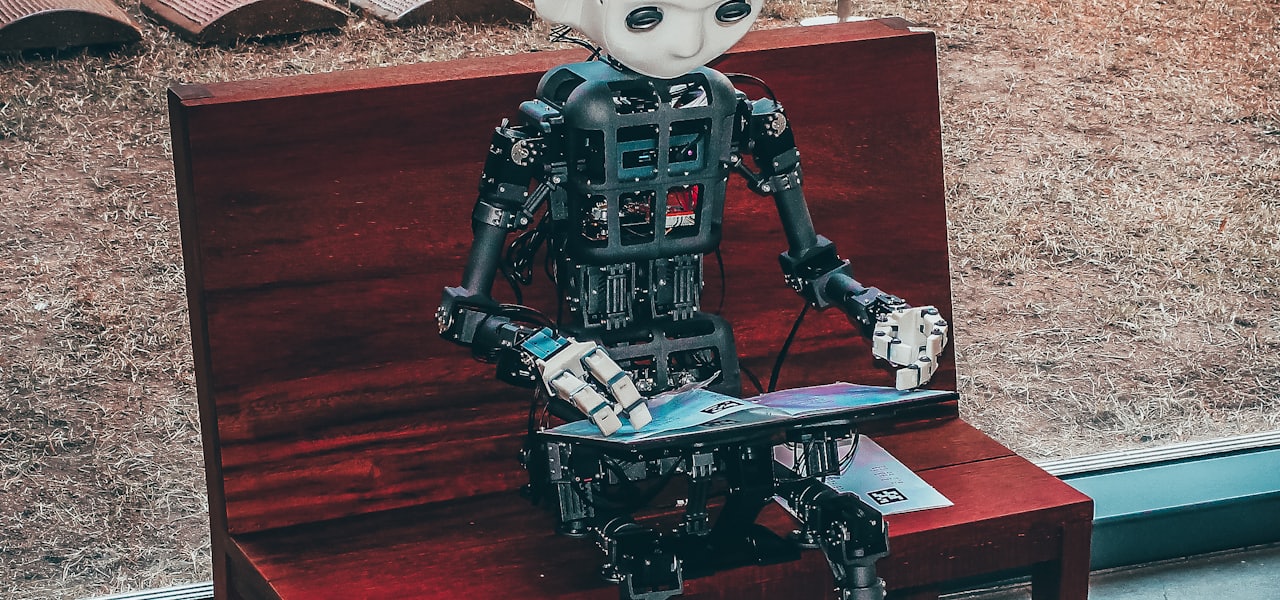
    Robotics is the interdisciplinary study and practice of the design, construction, operation, and use of robots. A roboticist is someone who specializes in robotics. Robotics usually combines four aspects of design work: a power source (e.g. a battery), mechanical construction, a control system (electrical circuits), and software (run by remote control or artificial intelligence). The goal of most robotics is to design machines that can assist humans in various fields, such as agriculture, construction, domestic work, food processing, inventory management, manufacturing, medicine, military, mining, space exploration, and transportation. Robots impact humans by displacing workers. Some expect this to occur at an increasing rate, leading to proposed solutions such as basic income. Robotics is itself a lucrative business that creates careers, especially for postgraduates. Roboticists often aim to create machines that seem to interface naturally with humans. The field is under active research and development, with areas of interest including robot kinematics and quantum robotics. == Design == Robotics usually combines four aspects of design work to create a robot: Power source: Potential energy sources include wired electricity, a battery, and/or petrol. Mechanical construction: A physical form or combination of forms is designed to functionally achieve tasks within a given range of environments. This can include locomotive elements such as wheels and caterpillar tracks, as well as hydraulic limbs and manipulators (e.g. hands). Control system: Electrical circuits (utilizing components such as diodes and transistors) are used to run software, govern motor movement, and read sensors. Software: A program is how a robot decides when or how to do something. Robotic programs can be run by remote control, artificial intelligence (AI), or a hybrid of the two. AI programming is an important part of robotic navigation and human–robot interaction. === Power source === Many different types of batteries can be used as a power source. Most are lead–acid batteries, which are safe and have relatively long shelf lives but are rather heavy compared to silver–cadmium batteries, which are much smaller in volume and much more expensive. Designing a battery-powered robot needs to take into account factors such as safety, cycle lifetime, and weight. Generators, often some type of internal combustion engine, can also be used, but are often mechanically complex and inefficient. Additionally, a tether could connect the robot to a power supply, saving weight and space, but requiring a cumbersome cable. Potential power sources include: Flywheel energy storage Hydraulics Nuclear Organic garbage (through anaerobic digestion) Pneumatics (compressed gases) Solar power === Mechanical construction === Actuators are the "muscles" of a robot, the parts which convert stored energy into movement. The most popular actuators are electric motors that rotate a wheel or gear and linear actuators that control factory robots. Most robots use electric motors—often brushed and brushless DC motors in portable robots or AC motors in industrial robots and computer numerical control machines—especially in systems with lighter loads and where the predominant form of motion is rotational. Meanwhile, linear actuators move in and out and often have quicker direction changes, particularly when large forces are needed, such as with industrial robotics. They are typically powered by oil or compressed air, but can also be powered by electricity, usually via a motor and a leadscrew. The mechanical rack and pinion is common. Recent alternatives to DC motors are piezoelectric motors, including ultrasonic motors, in which tiny piezoceramic elements vibrate many thousands of times per second, causing linear or rotary motion. One type uses the vibration of the piezo elements to step the motor in a circle or a straight line; another type uses the piezo elements to vibrate a nut or drive a screw. The advantages of these motors are nanometer resolution, speed, and force for their size. Series elastic actuation (SEA) relies on introducing intentional elasticity between the motor actuator and the load for robust force control. Due to the resultant lower reflected inertia, series elastic actuation improves safety during robot interactions or collisions. Further, it provides energy efficiency and shock absorption (mechanical filtering) while reducing excessive wear on the transmission and other components. This approach has successfully been employed in various robots, particularly advanced manufacturing robots and walking humanoid robots. The controller design of a series elastic actuator is most often performed within the passivity framework as it ensures the safety of interaction with unstructured environments. However, this framework suffers from stringent limitations imposed on the controller, which may impact performance. Pneumatic artificial muscles, also known as air muscles, are special tubes that expand (typically up to 42%) when air is forced inside them; they are used in some robot applications. Muscle wire, also known as shape memory alloy, is a material that contracts (under 5%) when electricity is applied; they have been used for some small robots. Electroactive polymers are a plastic material that can contract substantially (up to 380% activation strain) from electricity and have been used in the facial muscles and arms of humanoid robots, as well as to enable new robots to float, fly, swim or walk. Additionally, elastic carbon nanotubes are a promising experimental artificial muscle technology. The absence of defects in carbon nanotubes enables these filaments to deform elastically by several percent, with energy storage levels of perhaps 10 J/cm3 for metal nanotubes. Human biceps could be replaced with wire of this material measuring 8 millimetres (3⁄8 in) in diameter, feasibly allowing future robots to outperform humans. ==== Locomotion ==== Robots with only one or two wheel(s) can have advantages such as greater efficiency, reduced parts, and navigation through confined areas. A one-wheeled robot balances on a round ball; Carnegie Mellon University's Ballbot is the approximate height and width of a person. Several attempts have also been made to build spherical robots (also known as orb bots or ball bots), which move by spinning a weight inside the ball or rotating outer shells. Two-wheeled balancing robots generally use a gyroscope to detect how much a robot is falling and drive the wheels proportionally up to hundreds of times per second to counterbalance the fall, based on inverted pendulum dynamics. NASA's Robonaut has been mounted to a Segway for a similar effect. Most mobile robots have four wheels or continuous tracks. Six wheels can give better traction in outdoor terrain, while tracks provide even more grip. Tracked wheels are common for outdoor off-road robots, but are difficult to use indoors. A small number of skating robots have been developed, one of which is a multimodal walking and skating device with four legs and unpowered wheels. Several robots have been made that can walk on two legs, but not yet as reliably as a human. Many other robots have been built that walk on more than two legs, being significantly easier. Walking robots could be used for uneven terrains, providing a high degree of mobility and efficiency, but two-legged robots can currently only handle flat floors or perhaps stairs. Some approaches have included: The zero moment point (ZMP) is the algorithm used by robots such as Honda's ASIMO. The robot's onboard computer tries to keep the total inertial forces (the combination of Earth's gravity and the acceleration and deceleration of walking) exactly opposed by the floor reaction force (the force of the floor pushing back on the robot's foot). In this way, the two forces cancel out, leaving no moment (force causing the robot to rotate and fall over). Human observers note that this is not exactly how a human walks, with some describing ASIMO's walk as looking like it needs use the bathroom. ASIMO's walking algorithm utilizes some dynamic balancing, but requires a flat surface. Several robots, built in the 1980s by Marc Raibert at the MIT Leg Laboratory, successfully demonstrated very dynamic walking. Initially, a robot with only one leg, and a very small foot could stay upright simply by hopping. The movement is the same as that of a person on a pogo stick. As the robot falls to one side, it would jump slightly in that direction to catch itself. Soon, the algorithm was generalized to two and four legs. A bipedal robot was demonstrated running and even performing somersaults. A quadruped was also demonstrated which could trot, run, pace, and bound. A more advanced approach is a dynamic balancing algorithm, which constantly monitors the robot's motion and places the feet to maintain stability. This technique has been demonstrated by Anybots' Dexter robot (

    Read more →
  • Death of Elaine Herzberg

    Death of Elaine Herzberg

    The death of Elaine Herzberg (August 2, 1968 – March 18, 2018) was the first recorded case of a pedestrian fatality involving a self-driving car, after a collision that occurred late in the evening of March 18, 2018. Herzberg was pushing a bicycle across a four-lane road in Tempe, Arizona, United States, when she was struck by an Uber test vehicle, which was operating in self-drive mode with a human safety backup driver sitting in the driving seat. Herzberg was taken to the local hospital where she died of her injuries. Following the fatal incident, the National Transportation Safety Board (NTSB) issued a series of recommendations and sharply criticized Uber. The company suspended testing of self-driving vehicles in Arizona, where such testing had been approved since August 2016. Uber chose not to renew its permit for testing self-driving vehicles in California when it expired at the end of March 2018. Uber resumed testing in December 2018, starting in Pittsburgh, Pennsylvania. In March 2019, Arizona prosecutors ruled that Uber was not criminally responsible for the crash. The back-up driver of the vehicle was charged with negligent homicide, pled guilty to endangerment, and was sentenced to three years' probation. While Herzberg was the first pedestrian killed by a self-driving car, driver Gao Yaning died in a Tesla semi-autonomous car two years earlier. A reporter for The Washington Post compared Herzberg's fate with that of Bridget Driscoll who, in the United Kingdom in 1896, was the first pedestrian to be killed by an automobile. The Arizona incident has magnified the importance of collision avoidance systems for self-driving vehicles. == Collision summary == Herzberg was crossing Mill Avenue (North) from west to east, approximately 360 feet (110 m) south of the intersection with Curry Road, outside the designated pedestrian crosswalk, close to the Red Mountain Freeway. She was pushing a bicycle laden with shopping bags, and had crossed at least two lanes of traffic when she was struck at approximately 9:58 pm MST (UTC−07:00) by a prototype Uber self-driving car based on a Volvo XC90, which was traveling north on Mill. The vehicle had been operating in autonomous mode since 9:39 pm, nineteen minutes before it struck and killed Herzberg. The car's human safety backup driver, Rafaela Vasquez, did not intervene in time to prevent the collision. Vehicle telemetry obtained after the crash showed that the human operator responded by moving the steering wheel less than a second before impact, and she engaged the brakes less than a second after impact. == Cause investigation == The county district attorney's office recused itself from the investigation, due to a prior joint partnership with Uber promoting their services as an alternative to driving under the influence of alcohol. Accounts differ on the speed limit at the place of the incident. According to Tempe police the car was traveling in a 35 mph (56 km/h) zone, but this is contradicted by a posted speed limit of 45 mph (72 km/h). The National Transportation Safety Board (NTSB) sent a team of federal investigators to gather data from vehicle instruments, and to examine vehicle condition along with the actions taken by the safety driver. Their preliminary findings were substantiated by multiple event data recorders and proved the vehicle was traveling 43 miles per hour (69 km/h) when Herzberg was first detected 6 seconds (378 feet (115 m)) before impact; during 4.7 seconds the self driving system did not infer that emergency braking was needed. A vehicle traveling 43 mph (69 km/h) can generally stop within 89 feet (27 m) once the brakes are applied. The machine needed to be 1.3 seconds (82 feet (25 m)) away prior to discerning that emergency braking was required, whereas at least that much distance was required to stop. The system failed to behave properly. A total stopping distance of 76 feet itself would imply a safe speed under 25 mph (40 km/h). Human intervention was still legally required. Computer perception–reaction time would have been a speed limiting factor had the technology been superior to humans in ambiguous situations; however, the nascent computerized braking technology was disabled the day of the crash, and the machine's apparent 4.7-second perception–reaction (alarm) time allowed the car to travel 250 feet (76 m). Video released by the police on March 21 showed the safety driver was not watching the road moments before the vehicle struck Herzberg. === Environment === In widely disseminated remarks that would shape the narrative about the crash, which were later seen as prejudicial and subsequently contradicted by her own department, Tempe Police Chief Sylvia Moir was quoted stating that the collision was "unavoidable" based on the initial police investigation, which included a review of the video captured by an onboard camera. Moir faulted Herzberg for crossing the road in an unsafe manner: "It is dangerous to cross roadways in the evening hour when well-illuminated, managed crosswalks are available." According to Uber, safety drivers were trained to keep their hands very close to the wheel all the time while driving the vehicle so they were ready to quickly take control if necessary. The driver said it was like a flash, the person walked out in front of them. His [sic] first alert to the collision was the sound of the collision. [...] it's very clear it would have been difficult to avoid this collision in any kind of mode (autonomous or human-driven) based on how she came from the shadows right into the roadway. Tempe police released video on March 21, 2018, showing footage recorded by two onboard cameras: one forward-looking, and one capturing the safety driver's actions. The forward-facing video shows that the self-driving car was traveling in the far right lane when it struck Herzberg. The driver-facing video shows the safety driver was looking down prior to the collision. The Uber operator is responsible for intervening and taking manual control when necessary as well as for monitoring diagnostic messages, which are displayed on a screen in the center console. In an interview conducted after the crash with NTSB, the driver stated she was monitoring the center stack at the time of the collision. After the Uber video was released, journalist Carolyn Said noted the police explanation of Herzberg's path meant she had already crossed two lanes of traffic before she was struck by the autonomous vehicle. The Marquee Theatre and Tempe Town Lake are west of Mill Avenue, and pedestrians commonly cross mid-street without detouring north to the crosswalk at Curry. According to reporting by the Phoenix New Times, Mill Avenue contains what appears to be a brick-paved path in the median between the northbound and southbound lanes; however, posted signs prohibit pedestrians from crossing in that location. When the second of the Mill Avenue bridges over the town lake was added in 1994 for northbound traffic, the X-shaped crossover in the median was installed to accommodate the potential closing of one of the two road bridges. The purpose of this brick-paved structure is purely to divert cars from one side to the other if a bridge is closed to traffic, and although it may look like a crosswalk for pedestrians, it is in fact a temporary roadway with vertical curbs and warning signs. === Software issues === Michael Ramsey, a self-driving car expert with Gartner, characterized the video as showing "a complete failure of the system to recognize an obviously seen person who is visible for quite some distance in the frame. Uber has some serious explaining to do about why this person wasn't seen and why the system didn't engage." The NTSB preliminary report, however, noted that the software did order the car to brake 1.3 seconds before the collision. A video shot from the vehicle's dashboard camera showed the safety driver looking down, away from the road. It also appeared that the driver's hands were not hovering above the steering wheel, which is what drivers are instructed to do so they can quickly retake control of the car. Uber had moved from two employees in every car to one. The paired employees had been splitting duties: one ready to take over if the autonomous system failed, and another to keep an eye on what the computers were detecting. The second person was responsible for keeping track of system performance as well as labeling data on a laptop computer. Mr. Kallman, the Uber spokesman, said the second person was in the car for purely data related tasks, not safety. When Uber moved to a single operator, some employees expressed safety concerns to managers, according to the two people familiar with Uber's operations. They were worried that going solo would make it harder to remain alert during hours of monotonous driving. The recorded telemetry showed the system had detected Herzberg six seconds before the crash, and classified her first as an unknown object, then as a

    Read more →
  • Multi Autonomous Ground-robotic International Challenge

    Multi Autonomous Ground-robotic International Challenge

    The Multi Autonomous Ground-robotic International Challenge (MAGIC) is a 1.6 million dollar prize competition for autonomous mobile robots funded by TARDEC and the DSTO, the primary research organizations for Tank and Defense research in the United States and Australia respectively. The goal of the competition is to create multi-vehicle robotic teams that can execute an intelligence, surveillance and reconnaissance mission in a dynamic urban environment. The challenge required competitors to map a 500 m x 500 m challenge area in under 3.5 hours and to correctly locate, classify and recognise all simulated threats. The challenge event was conducted in Adelaide, Australia, during November 2010. == Competitors == Initially 12 teams were selected for the competition in November 2009, of which 10 teams received funding. These included: MAGICian – Adelaide/Perth, Australia (UWA, ECU, Flinders, Thales) Strategic Engineering – Adelaide, Australia (U. Adelaide) Northern Hunters – Canada (Royal Military College of Canada) Chiba Team – Japan (Chiba University) Cappadocia – Ankara, Turkey (ASELSAN, Ohio State University) RASR – Gaithersburg, Md. (Robotics Research, LLC; QinetiQ; Embry-Riddle Aeronautical University) Team Cornell – US (Cornell University) Team Michigan – Ann Arbor, Mich. (University of Michigan) Virginia Tech – US (Virginia Tech) University of Pennsylvania – Philadelphia (University of Pennsylvania) Numinence – Brisbane, Australia (Numinence Pty Ltd, La Trobe University) UNSW – Sydney, Australia (UNSW) The first downselection trial required teams to map an indoor area and outdoor area, and to demonstrate distributing and handing over tasks between robots. During the first downselection trial, the top six teams were selected: Cappadocia – Ankara, Turkey MAGICian – Adelaide/Perth, Australia RASR – Gaithersburg, Md. Team Michigan – Ann Arbor, Mich. University of Pennsylvania – Philadelphia Chiba Team – Japan Before the finals were held, Chiba Team withdrew from the competition, leaving five competitors. == Event == Ultimately the overall goal of fully autonomous operations without human intervention was not achieved, however, the Secretary for Defence stated "The competing vehicles demonstrated new advances in robotics technology, which are very promising for their potential deployment in combat zones where they can replace our troops in carrying out life-threatening tasks" and considered the competition a success. == Results == The official results of the competition were: First – Team Michigan ($750,000 prize) Second – University of Pennsylvania ($250,000 prize) Third – RASR ($100,000 prize) Fourth – MAGICian & Cappadocia The "Old Ram Shed Challenge" was a single-day competition held after the completion of MAGIC. It was smaller in scale, allowing all of the teams to demonstrate their systems during a single day. The University of Pennsylvania won this challenge, having found a greater number of the target objects than the other teams. == Technology == Key technology used by all teams was computer vision, sensor fusion, human-robot interaction, and simultaneous localization and mapping (SLAM). Team Michigan, a collaboration between the University of Michigan's APRIL Lab and Soar Technology, Inc., had the largest fleet of 14 robots, developed their own Inertial Measurement Unit, and created their skid steer robot chassis out of Baltic birch plywood. Additionally, they had minimal reliance on GPS and used bandwidth limited 900 MHz radios for all telemetry, imaging, and status communications between all robots and the ground station. The code was written primarily in Java and each robot was equipped with an actuated 2D LIDAR, along with a unique 2D barcode for inter-robot recognition. The University of Pennsylvania team consisted of only four members. All code was written using Matlab. The robots were equipped with omnidirectional vision. RASR used the Foster-Miller TALON vehicle. MAGICian used the WAMbot robots developed by The University of Western Australia, Edith Cowan University and Thales Australia. Code was written in C++ and Java. The robots were equipped with SICK laser scanners. See the September/October 2012 special issue of the Journal of Field Robotics for contest highlights, technical approaches taken by several of the teams, and an explanation of the evaluation metrics used by organizers.

    Read more →