The International Journal on Artificial Intelligence Tools was founded in 1992 and is published by World Scientific. It covers research on artificial intelligence (AI) tools, including new architectures, languages and algorithms. Topics include AI in Bioinformatics, Cognitive Informatics, Knowledge-Based/Expert Systems and Object-Oriented Programming for AI. == Abstracting and indexing == The journal is abstracted and indexed in: Inspec Science Citation Index Expanded ISI Alerting Services CompuMath Citation Index Current Contents/Engineering, Computing, and Technology
Teaspiller
Teaspiller was a US-based web application for customers to find accountants and hire them to do their taxes and accounting online. In 2013 the company was acquired by Intuit, Inc and added to its TurboTax product line. The Teaspiller employees and code were all acquired and the product was renamed as "TurboTax CPA select". It enabled accountants to work remotely with clients (share files, send secure messages, schedule appointments), as well as find new clients looking for their specific skills through a complex search algorithm. This was done through extended profiles containing licensing information, professional histories, user ratings, peer endorsements, association memberships, and practice areas. The service had been called an H&R Block killer by Business Insider as it helped customers find accountants to prepare tax returns online. As of 2011 it had 20,000 US accountants listed on the site. The application was built using the Django framework. == History == Teaspiller was built by Vemdara, LLC, a web company based in New York and founded in 2009 by Amit Vemuri (a former VP at Travelocity). The web application was launched in 2010. In 2013 the company was acquired by Intuit as part of their TurboTax product line and renamed as "TurboTax CPA select".
Outline of robotics
The following outline is provided as an overview of and topical guide to robotics: Robotics is a branch of mechanical engineering, electrical engineering and computer science that deals with the design, construction, operation, and application of robots, as well as computer systems for their control, sensory feedback, and information processing. These technologies deal with automated machines that can take the place of humans in dangerous environments or manufacturing processes, or resemble humans in appearance, behaviour, and or cognition. Many of today's robots are inspired by nature contributing to the field of bio-inspired robotics. The word "robot" was introduced to the public by Czech writer Karel Čapek in his play R.U.R. (Rossum's Universal Robots), published in 1920. The term "robotics" was coined by Isaac Asimov in his 1941 science fiction short-story "Liar!" == Nature of robotics == Robotics can be described as: An applied science – scientific knowledge transferred into a physical environment. A branch of computer science – A branch of electrical engineering – A branch of mechanical engineering – Research and development – A branch of technology – == Branches of robotics == Adaptive control – control method used by a controller which must adapt to a controlled system with parameters which vary, or are initially uncertain. For example, as an aircraft flies, its mass will slowly decrease as a result of fuel consumption; a control law is needed that adapts itself to such changing conditions. Aerial robotics – development of unmanned aerial vehicles (UAVs), commonly known as drones, aircraft without a human pilot aboard. Their flight is controlled either autonomously by onboard computers or by the remote control of a pilot on the ground or in another vehicle. Android science – interdisciplinary framework for studying human interaction and cognition based on the premise that a very humanlike robot (that is, an android) can elicit human-directed social responses in human beings. Anthrobotics – science of developing and studying robots that are either entirely or in some way human-like. Artificial intelligence – the intelligence of machines and the branch of computer science that aims to create it. Artificial neural networks – a mathematical model inspired by biological neural networks. Autonomous car – an autonomous vehicle capable of fulfilling the human transportation capabilities of a traditional car Autonomous research robotics – Bayesian network – BEAM robotics – a style of robotics that primarily uses simple analogue circuits instead of a microprocessor in order to produce an unusually simple design (in comparison to traditional mobile robots) that trades flexibility for robustness and efficiency in performing the task for which it was designed. Behavior-based robotics – the branch of robotics that incorporates modular or behavior based AI (BBAI). Bio-inspired robotics – making robots that are inspired by biological systems. Biomimicry and bio-inspired design are sometimes confused. Biomimicry is copying the nature while bio-inspired design is learning from nature and making a mechanism that is simpler and more effective than the system observed in nature. Biomimetic – see Bionics. Biomorphic robotics – a sub-discipline of robotics focused upon emulating the mechanics, sensor systems, computing structures and methodologies used by animals. Bionics – also known as biomimetics, biognosis, biomimicry, or bionical creativity engineering is the application of biological methods and systems found in nature to the study and design of engineering systems and modern technology. Biorobotics – a study of how to make robots that emulate or simulate living biological organisms mechanically or even chemically. Cloud robotics – is a field of robotics that attempts to invoke cloud technologies such as cloud computing, cloud storage, and other Internet technologies centered around the benefits of converged infrastructure and shared services for robotics. Cognitive robotics – views animal cognition as a starting point for the development of robotic information processing, as opposed to more traditional Artificial Intelligence techniques. Clustering – Computational neuroscience – study of brain function in terms of the information processing properties of the structures that make up the nervous system. Robot control – a study of controlling robots Robotics conventions – Data mining Techniques – Degrees of freedom – in mechanics, the degree of freedom (DOF) of a mechanical system is the number of independent parameters that define its configuration. It is the number of parameters that determine the state of a physical system and is important to the analysis of systems of bodies in mechanical engineering, aeronautical engineering, robotics, and structural engineering. Developmental robotics – a methodology that uses metaphors from neural development and developmental psychology to develop the mind for autonomous robots Digital control – a branch of control theory that uses digital computers to act as system controllers. Digital image processing – the use of computer algorithms to perform image processing on digital images. Dimensionality reduction – the process of reducing the number of random variables under consideration, and can be divided into feature selection and feature extraction. Distributed robotics – Electronic stability control – is a computerized technology that improves the safety of a vehicle's stability by detecting and reducing loss of traction (skidding). Evolutionary computation – Evolutionary robotics – a methodology that uses evolutionary computation to develop controllers for autonomous robots Extended Kalman filter – Flexible Distribution functions – Feedback control and regulation – Human–computer interaction – a study, planning and design of the interaction between people (users) and computers Human robot interaction – a study of interactions between humans and robots Intelligent vehicle technologies – comprise electronic, electromechanical, and electromagnetic devices - usually silicon micromachined components operating in conjunction with computer controlled devices and radio transceivers to provide precision repeatability functions (such as in robotics artificial intelligence systems) emergency warning validation performance reconstruction. Computer vision – Machine vision – Kinematics – study of motion, as applied to robots. This includes both the design of linkages to perform motion, their power, control and stability; also their planning, such as choosing a sequence of movements to achieve a broader task. Laboratory robotics – the act of using robots in biology or chemistry labs Robot learning – learning to perform tasks such as obstacle avoidance, control and various other motion-related tasks Direct manipulation interface – In computer science, direct manipulation is a human–computer interaction style which involves continuous representation of objects of interest and rapid, reversible, and incremental actions and feedback. The intention is to allow a user to directly manipulate objects presented to them, using actions that correspond at least loosely to the physical world. Manifold learning – Microrobotics – a field of miniature robotics, in particular mobile robots with characteristic dimensions less than 1 mm Motion planning – (a.k.a., the "navigation problem", the "piano mover's problem") is a term used in robotics for the process of detailing a task into discrete motions. Motor control – information processing related activities carried out by the central nervous system that organize the musculoskeletal system to create coordinated movements and skilled actions. Nanorobotics – the emerging technology field creating machines or robots whose components are at or close to the scale of a nanometer (10−9 meters). Passive dynamics – refers to the dynamical behavior of actuators, robots, or organisms when not drawing energy from a supply (e.g., batteries, fuel, ATP). Programming by Demonstration – an End-user development technique for teaching a computer or a robot new behaviors by demonstrating the task to transfer directly instead of programming it through machine commands. Quantum robotics – a subfield of robotics that deals with using quantum computers to run robotics algorithms more quickly than digital computers can. Rapid prototyping – automatic construction of physical objects via additive manufacturing from virtual models in computer aided design (CAD) software, transforming them into thin, virtual, horizontal cross-sections and then producing successive layers until the items are complete. As of June 2011, used for making models, prototype parts, and production-quality parts in relatively small numbers. Reinforcement learning – an area of machine learning in computer science, concerned with how an agent ought to take actions in an environment so as to maximize some notion of cumulative reward. Robot
Educational robotics
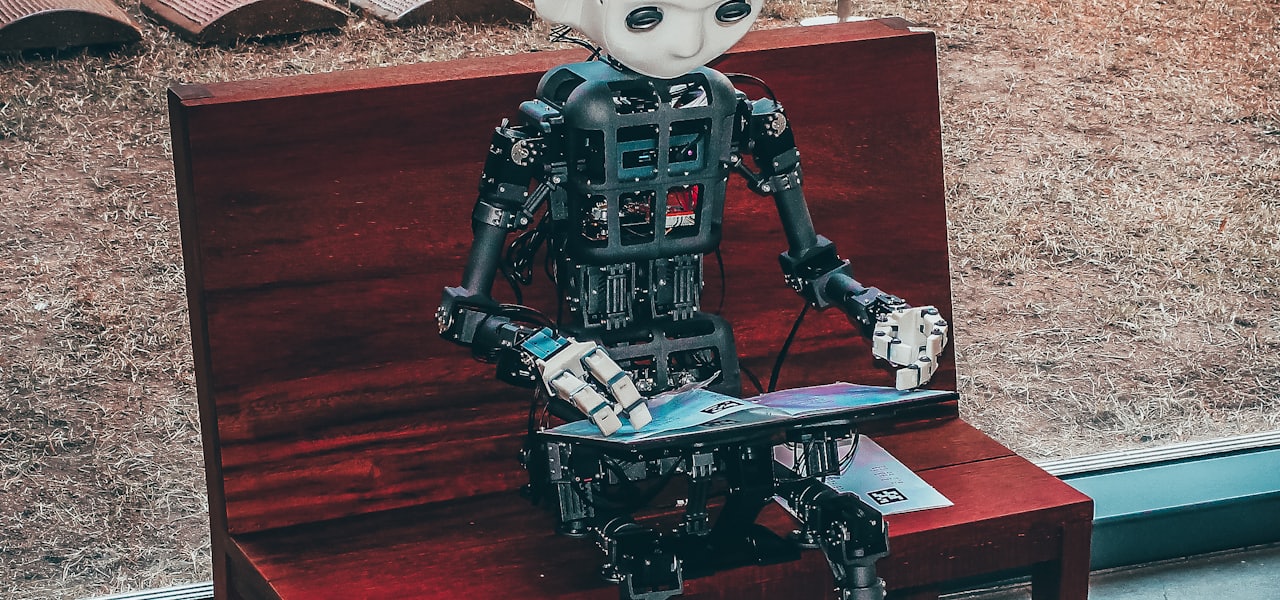
Educational robotics teaches the design, analysis, application and operation of robots. Robots include articulated robots, mobile robots or autonomous vehicles. Educational robotics can be taught from elementary school to graduate programs. Robotics may also be used to motivate and facilitate the instruction other, often foundational, topics such as computer programming, artificial intelligence or engineering design. == Education and training == Robotics engineers design robots, maintain them, develop new applications for them, and conduct research to expand the potential of robotics. Robots have become a popular educational tool in some middle and high schools, as well as in numerous youth summer camps, raising interest in programming, artificial intelligence and robotics among students. First-year computer science courses at several universities now include programming of a robot in addition to traditional software engineering-based coursework. == Category of Educational robotics == The categories of educational robots seen as having more than one category. It can be alienated into different categories based on their physical design and coding method. Generally they are categorised as arm robots, wheeled mobile robots and humanoid robots. Tangibly, coded robots uses a physical means of coding instead of the screens coding. === Initiatives in schools === Leachim, was a robot teacher programmed with the class curricular, as well as certain biographical information on the 40 students whom it was programmed to teach. Leachim could synthesize human speech using Diphone synthesis. It was invented by Michael J. Freeman in 1974 and was tested in a fourth grade classroom in the Bronx, New York. === Post-secondary degree programs === From approximately 1960 through 2005, robotics education at post-secondary institutions took place through elective courses, thesis experiences and design projects offered as part of degree programs in traditional academic disciplines, such as mechanical engineering, electrical engineering, industrial engineering or computer science. Since 2005, more universities have begun granting degrees in robotics as a discipline in its own right, often under the name "Robotic Engineering". Based on a 2015 web-based survey of robotics educators, the degree programs and their estimates annual graduates are listed alphabetically below. Note that only official degree programs where the word "robotics" appears on the transcript or diploma are listed here; whereas degree programs in traditional disciplines with course concentrations or thesis topics related to robotics are deliberately omitted. === Certification === The Robotics Certification Standards Alliance (RCSA) is an international robotics certification authority that confers various industry- and educational-related robotics certifications. === Summer robotics camp === Several summer camp programs include robotics as part of their core curriculum. In addition, youth summer robotics programs are frequently offered by celebrated museums such as the American Museum of Natural History and The Tech Museum of Innovation in Silicon Valley, CA, just to name a few. There are of benefits that come from attending robotics camps. It teaches students how to use teamwork, resilience and motivation, and decision-making. Students learn teamwork because most camps involve exciting activities requiring teamwork. Resilience and motivation is expected because by completing the challenging programs, students feel talented and accomplished after they complete the program. Also students are given unique situations making them make decisions to further their situation. === Educational robotics in special education === Educational robotics can be a useful tool in early and special education. According to a journal on new perspectives in science education, educational robotics can help to develop abilities that promote autonomy and assist their integration into society. Social and personal skills can also be developed through educational robotics. Using Lego Mindstorms NXT, schoolteachers were able to work with middle school aged children in order to develop programs and improve the children's social and personal skills. Additionally, problem solving skills and creativity were utilized through the creation of artwork and scenery to house the robots. Other studies show the benefits of educational robotics in special education as promoting superior cognitive functions, including executive functions. This can lead to an increased ability in "problem solving, reasoning and planning in typically developing preschool children." Through eight weeks of weekly forty-five-minute group sessions using the Bee-Bot, an increase in interest, attention, and interaction between both peers and adults was found in the school and preschool-aged children with Down Syndrome. This study suggests that educational robotics in the classroom can also lead to an improvement in visuo-spatial memory and mental planning. Furthermore, executive functions seemed to be possible in one child during this study.
BeeSafe
BeeSafe is a personal safety mobile app launched in 2015 as a Slovak startup. It is a location-based security service that notifies family members and friends in case the user of the app gets in danger. The app has received numerous awards. The app has more than 700 downloads and 250 active logins from more than 60 countries worldwide. == History == BeeSafe was founded on March 20, 2015 by Peter Stražovec and Michal Kačerík. The project was a winner of Žilina’s Startup Weekend 2013 and a StartupAwards.SK 2015 finalist. Later on, the app was released in the Android and iOS marketplace. The whole BeeSafe project was in The Spot booster and incubator in Bratislava for three months. BeeSafe entered into an agreement with the city of Piešťany in November 2015 to increase the security of its citizen by connecting the mobile app with the police platform. It is the first city that started using the BeeSafe platform. Further on, the application tries to help people in other Slovak cities. The cities can see the users only if they are in danger. == Awards == BeeSafe app received the Via Bona award, it is a winner of a Slovak startup and has other nominations too.
Ware report
Security Controls for Computer Systems, commonly called the Ware report, is a 1970 text by Willis Ware that was foundational in the field of computer security. == Development == A defense contractor in St. Louis, Missouri, had bought an IBM mainframe computer, which it was using for classified work on a fighter aircraft. To provide additional income, the contractor asked the Department of Defense (DoD) for permission to sell computer time on the mainframe to local businesses via remote terminals, while the classified work continued. At the time, the DoD did not have a policy to cover this. The DoD's Advanced Research Projects Agency (DARPA) asked Ware - a RAND employee - to chair a committee to examine and report on the feasibility of security controls for computer systems. The committee's report was a classified document given in January 1970 to the Defense Science Board (DSB), which had taken over the project from ARPA. After declassification, the report was published by RAND in October 1979. == Influence == The IEEE Computer Society said the report was widely circulated, and the IEEE Annals of the History of Computing said that it, together with Ware's 1967 Spring Joint Computer Conference session, marked the start of the field of computer security. The report influenced security certification standards and processes, especially in the banking and defense industries, where the report was instrumental in creating the Orange Book.
Time-compressed speech
Time-compressed speech refers to an audio recording of verbal text in which the text is presented in a much shorter time interval than it would through normally-paced real time speech. The basic purpose is to make recorded speech contain more words in a given time, yet still be understandable. For example: a paragraph that might normally be expected to take 20 seconds to read, might instead be presented in 15 seconds, which would represent a time-compression of 25% (5 seconds out of 20). The term "time-compressed speech" should not be confused with "speech compression", which controls the volume range of a sound, but does not alter its time envelope. == Methods == While some voice talents are capable of speaking at rates significantly in excess of general norms, the term "time-compressed speech" most usually refers to examples in which the time-reduction has been accomplished through some form of electronic processing of the recorded speech. In general, recorded speech can be electronically time-compressed by: increasing its speed (linear compression); removing silences (selective editing); a combination of the two (non-linear compression). The speed of a recording can be increased, which will cause the material to be presented at a faster rate (and hence in a shorter amount of time), but this has the undesirable side-effect of increasing the frequency of the whole passage, raising the pitch of the voices, which can reduce intelligibility. There are normally silences between words and sentences, and even small silences within certain words, both of which can be reduced or removed ("edited-out") which will also reduce the amount of time occupied by the full speech recording. However, this can also have the effect of removing verbal "punctuation" from the speech, causing words and sentences to run together unnaturally, again reducing intelligibility. Vowels are typically held a minimum of 20 milliseconds, over many cycles of the fundamental pitch. DSP systems can detect the beginning and end of each cycle and then skip over some fraction of those cycles, causing the material to be presented at a faster rate, without changing the pitch, maintaining a "normal" tone of voice. The current preferred method of time-compression is called "non-linear compression", which employs a combination of selectively removing silences; speeding up the speech to make the reduced silences sound normally-proportioned to the text; and finally applying various data algorithms to bring the speech back down to the proper pitch. This produces a more acceptable result than either of the two earlier techniques; however, if unrestrained, removing the silences and increasing the speed can make a selection of speech sound more insistent, possibly to the point of unpleasantness. == Applications == === Advertising === Time-compressed speech is frequently used in television and radio advertising. The advantage of time-compressed speech is that the same number of words can be compressed into a smaller amount of time, reducing advertising costs, and/or allowing more information to be included in a given radio or TV advertisement. It is usually most noticeable in the information-dense caveats and disclaimers presented (usually by legal requirement) at the end of commercials—the aural equivalent of the "fine print" in a printed contract. This practice, however, is not new: before electronic methods were developed, spokespeople who could talk extremely quickly and still be understood were widely used as voice talents for radio and TV advertisements, and especially for recording such disclaimers. === Education === Time-compressed speech has educational applications such as increasing the information density of trainings, and as a study aid. A number of studies have demonstrated that the average person is capable of relatively easily comprehending speech delivered at higher-than-normal rates, with the peak occurring at around 25% compression (that is, 25% faster than normal); this facility has been demonstrated in several languages. Conversational speech (in English) takes place at a rate of around 150 wpm (words per minute), but the average person is able to comprehend speech presented at rates of up to 200-250 wpm without undue difficulty. Blind and severely visually impaired subjects scored similar comprehension levels at even higher rates, up to 300-350 wpm. Blind people have been found to use time-compressed speech extensively, for example, when reviewing recorded lectures from high school and college classes, or professional trainings. Comprehension rates in older blind subjects have been found to be as good, or in some cases better than those found in younger sighted subjects. Other studies have determined that the ability to comprehend highly time-compressed speech tends to fall off with increased age, and is also reduced when the language of the time-compressed speech is not the listener's native language. Non-native speakers can, however, improve their comprehension level of time-compressed speech with multiday training. === Voice Mail === Voice mail systems have employed time-compressed speech since as far back as the 1970s. In this application, the technology enables the rapid review of messages in high-traffic systems, by a relatively small number of people. === Streaming Multimedia === Time-compressed speech has been explored as one of a variety of interrelated factors which may be manipulated to increase the efficiency of streaming multimedia presentations, by significantly reducing the latency times involved in the transfer of large digitally encoded media files.